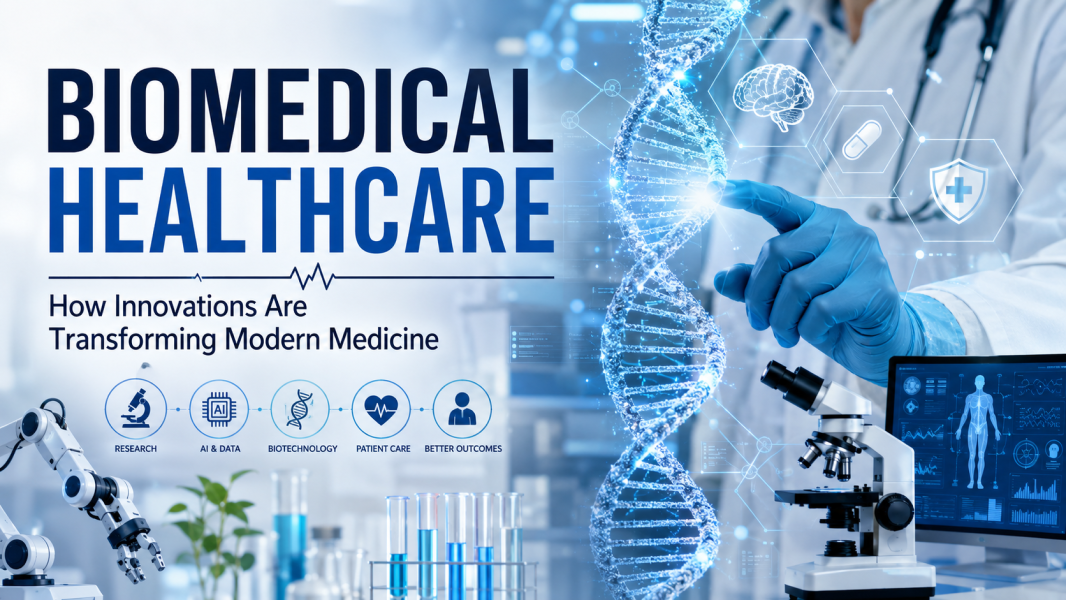
Biomedical Healthcare is reshaping modern medicine with smarter diagnosis, personalized care, medical devices, biotechnology, and innovative treatments.
How much could modern medicine change if doctors could detect disease earlier, design treatments around each patient, and use technology to support care?
Biomedical healthcare is transforming medicine by combining biology, medical science, engineering, and technology. It supports earlier diagnosis, smarter treatments, advanced medical devices, and more personalized patient care. From artificial intelligence to regenerative medicine, these innovations are making healthcare more precise, connected, and effective.
🧬 What Is Biomedical Healthcare?
Biomedical healthcare brings scientific research and medical practice closer together. It uses knowledge of the human body to develop better ways to prevent, diagnose, and treat health problems. Researchers, doctors, engineers, and technology experts often work together in this field.
The goal is not simply to create new technology. It is to solve real healthcare problems. Biomedical research can lead to new diagnostic tools, implants, medicines, laboratory tests, and treatment methods. As a result, patients may receive faster and more targeted care.
Some important areas include:
- Medical devices and implants
- Biotechnology and genetic research
- Diagnostic testing
- Artificial intelligence in healthcare
- Regenerative medicine
- Pharmaceutical development
- Wearable health technology
🔬 Why Biomedical Innovation Matters In Medicine
Traditional healthcare often depends on established tests and treatment methods. These remain important, but new biomedical technologies can give doctors more information. Better information can help healthcare professionals make more informed decisions.
Biomedical innovation also supports early detection and prevention. A disease found at an earlier stage may be easier to manage. For patients, this can mean fewer complications, more treatment choices, and better quality of life. 🩺
| Biomedical Area | Main Purpose | Potential Patient Benefit |
| Diagnostic Technology | Detect health conditions | Earlier diagnosis |
| Medical Devices | Support treatment | Better patient care |
| Biotechnology | Develop biological solutions | Targeted therapies |
| AI Healthcare Tools | Analyze medical data | Faster clinical insights |
| Regenerative Medicine | Repair damaged tissue | Improved recovery |
🤖 How AI Is Changing Biomedical Healthcare
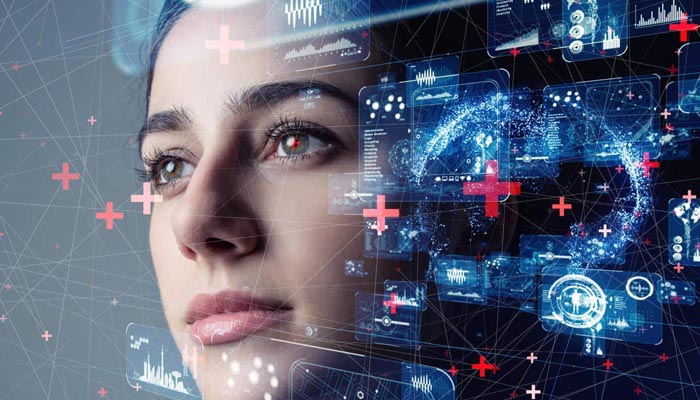
Artificial intelligence is becoming an important part of modern biomedical research. AI systems can analyze large amounts of medical information much faster than humans can. This may help researchers identify patterns that are difficult to notice manually.
For example, AI tools can assist with medical imaging and research. They may help identify unusual patterns in scans or organize complex patient data. However, AI is designed to support healthcare professionals, not replace them.
AI can also speed up biomedical research by helping scientists analyze:
- Medical images
- Biological datasets
- Drug candidates
- Genetic information
- Clinical research data
The biggest opportunity comes from combining AI with human expertise. Doctors provide clinical judgment, while technology can help process information more efficiently. 💡
🧪 The Role Of Biotechnology In Modern Medicine
Biotechnology uses living systems, cells, or biological processes to develop healthcare solutions. It has helped expand the possibilities of medicine far beyond traditional drugs and procedures.
Modern biotechnology supports areas such as vaccines, biologic medicines, genetic testing, and advanced therapies. Researchers can study how genes, proteins, and cells behave to better understand disease.
This approach can also support precision medicine. Instead of treating every patient in exactly the same way, healthcare teams can consider individual biological differences. That can help make certain treatments more targeted.
🧬 Personalized Medicine Is Becoming More Practical
Imagine receiving treatment based partly on your unique biological information rather than only your symptoms. That is the basic idea behind personalized medicine.
Genetic information, medical history, lifestyle factors, and other data can help healthcare professionals understand individual differences. This information may influence decisions about testing, prevention, or treatment.
| Approach | Traditional Model | Personalized Model |
| Diagnosis | General clinical information | Multiple individual data points |
| Treatment | Common treatment approach | More targeted options |
| Risk Assessment | Population-based patterns | Individual risk factors |
| Monitoring | Periodic visits | More continuous tracking |
Personalized medicine does not mean every patient receives a completely unique treatment. Instead, it means healthcare decisions can become more informed and individualized. This shift could improve treatment selection while reducing unnecessary interventions.
🦾 Medical Devices Are Getting Smarter
Medical devices have come a long way from basic diagnostic equipment. Today, biomedical engineers are developing smarter implants, monitoring systems, surgical tools, and assistive technologies.
Wearable devices can track information such as heart rate, activity, sleep, and other health measurements. More advanced medical devices can support people with specific medical needs or help doctors monitor patients remotely.
Smart devices can offer several advantages:
- Continuous health monitoring
- Faster collection of patient data
- Remote patient support
- Improved mobility
- More convenient healthcare management
⚙️ The important change is connectivity. Devices can increasingly work as part of a larger healthcare system instead of operating alone.
🧫 Regenerative Medicine And Tissue Engineering
Some biomedical researchers are exploring ways to help the body repair damaged tissues. This field is known as regenerative medicine.
Tissue engineering combines biology and engineering to explore how damaged or lost tissue might be repaired or replaced. Researchers study cells, biomaterials, and biological signals to understand how regeneration can occur.
Stem cell research is another important area within this field. While many regenerative approaches are still developing, the long-term goal is exciting: helping the body restore function rather than simply managing damage.
💊 Biomedical Research Is Improving Drug Development
Developing a new medicine can take years of research and testing. Biomedical innovation is helping researchers understand diseases at deeper biological levels.
Scientists can study cells, proteins, genes, and disease pathways to identify potential treatment targets. Advanced laboratory methods can also help researchers evaluate drug candidates before they reach clinical testing.
This can support a more systematic development process:
Disease Research → Target Identification → Drug Discovery → Testing → Clinical Evaluation → Patient Treatment
However, new technology does not remove the need for careful testing. Safety, effectiveness, side effects, and long-term outcomes must still be evaluated before treatments become widely available.
🩻 Better Diagnostics Can Lead To Earlier Care
Diagnosis is one of the most important parts of healthcare. If a condition is missed or detected late, treatment may become more difficult.
Biomedical innovation is creating new approaches to diagnostic testing. Advanced imaging, molecular testing, biomarkers, and laboratory technologies can provide additional information about what is happening inside the body.
Earlier detection can make a major difference in many diseases. It may give healthcare professionals more time to confirm a diagnosis and develop an appropriate care plan. Better diagnostics can therefore support better decisions. 🔎
| Innovation | Healthcare Application | Key Advantage |
| Biomarker Testing | Disease detection | Biological insights |
| Advanced Imaging | Medical diagnosis | Detailed visualization |
| Genetic Testing | Risk assessment | Individual information |
| Wearable Sensors | Health monitoring | Continuous data |
| Molecular Diagnostics | Disease identification | Precise testing |
🌐 Digital Healthcare And Remote Monitoring
Biomedical healthcare is also becoming more connected. Digital platforms can allow patients and healthcare teams to share information without every interaction requiring an in-person visit.
Remote monitoring can be useful for people who need regular health checks. Wearable sensors and connected devices may collect information that healthcare professionals can review over time.
This approach can make healthcare more convenient. It may also help healthcare teams notice changes sooner. Still, privacy and data security must remain central as more medical information moves through digital systems.
👩⚕️ What Does The Future Of Biomedical Healthcare Look Like?
The future will likely involve closer collaboration between medicine, engineering, biology, and computing. Instead of relying on one technology, healthcare may combine several tools to create a more complete picture of each patient.
For example, a future healthcare system could combine genetic information, imaging, wearable data, laboratory results, and clinical history. AI could help organize that information, while doctors use their expertise to interpret it.
The most promising developments may include:
- More precise diagnostic tools
- Smarter medical implants
- AI-assisted research
- Personalized treatment strategies
- Advanced regenerative therapies
- Connected healthcare devices
- Faster biomedical research
🚀 The goal should remain simple: use innovation to make healthcare safer, more effective, and more patient-centered.
⚠️ What Challenges Does Biomedical Innovation Face?
Innovation brings opportunities, but it also creates challenges. New technologies can be expensive to develop and may not immediately be available to everyone.
There are also questions about patient privacy, medical data, ethical research, and responsible use of AI. Healthcare professionals need reliable evidence before adopting new technologies on a large scale.
Another challenge is accessibility. A breakthrough has limited impact if patients cannot afford it or healthcare systems cannot provide it. For biomedical innovation to create lasting change, scientific progress must be matched by responsible implementation.
🏥 How Biomedical Healthcare Benefits Patients
Ultimately, biomedical healthcare matters because it can improve the patient experience. Better tools can help healthcare professionals gather information, identify problems, select treatments, and monitor progress.
Patients may benefit from more convenient monitoring and increasingly targeted care. New technologies may also create treatment options for conditions that were previously difficult to manage.
The impact can be seen across the healthcare journey:
- Prevention: Identify risks earlier.
- Diagnosis: Find diseases more accurately.
- Treatment: Select appropriate therapeutic options.
- Monitoring: Track changes over time.
- Recovery: Support rehabilitation and long-term care.
These benefits show why biomedical innovation is more than a technology trend. It is becoming an important part of how modern healthcare evolves.
🌟 The Human Side Of Biomedical Innovation
Technology may be at the center of biomedical research, but patients remain the reason behind it. A sophisticated device has little value if it does not improve someone’s care.
Healthcare professionals also play a critical role. Doctors, nurses, researchers, engineers, and laboratory specialists bring knowledge and experience that technology cannot replace.
The best biomedical innovation combines advanced science with human care. That balance can help ensure that progress remains practical, ethical, and focused on real patient needs.
🔮 What Is Next For Biomedical Healthcare?
Biomedical healthcare is moving toward a future where medicine can become more predictive, precise, and connected. AI, biotechnology, medical devices, regenerative medicine, and personalized healthcare are all contributing to this shift.
The journey will not happen overnight. New discoveries must go through research, validation, regulation, and careful clinical use. Yet the direction is clear: modern medicine is becoming increasingly data-driven and biologically informed.
The most meaningful progress will come when innovation solves practical problems. Better diagnosis, safer treatments, earlier intervention, and stronger patient outcomes should remain the ultimate goals.
✅ Conclusion
Biomedical healthcare is transforming modern medicine by bringing together biology, technology, engineering, and clinical expertise. Innovations in AI, biotechnology, personalized medicine, diagnostics, medical devices, and regenerative medicine are opening new possibilities for patient care.
The future is not simply about using more technology. It is about using the right technology to solve real healthcare challenges. When scientific innovation is combined with responsible medical practice, it can help create healthcare that is more precise, accessible, and patient-focused.
❓ Frequently Asked Questions
What Is Biomedical Healthcare Used For?
Biomedical healthcare supports disease prevention, diagnosis, treatment, and monitoring. It combines medical science with biology, engineering, and technology. Its goal is to improve patient care and health outcomes.
How Is AI Used In Biomedical Healthcare?
AI can analyze medical images, research data, and biological information. It may help healthcare professionals identify patterns and make informed decisions. Human expertise remains essential for clinical judgment.
Why Is Personalized Medicine Important?
Personalized medicine considers individual biological and medical differences. This can help healthcare professionals select more suitable testing or treatment approaches. It aims to make care more targeted and effective.
What Are Biomedical Medical Devices?
Biomedical medical devices are technologies designed to support diagnosis, treatment, monitoring, or patient function. Examples include implants, wearable sensors, and specialized medical equipment. Their applications vary across different healthcare needs.
What Is The Future Of Biomedical Healthcare?
The future may include smarter diagnostics, connected devices, personalized treatments, and advanced regenerative therapies. AI and biotechnology are likely to play major roles. Responsible research and patient safety will remain essential.